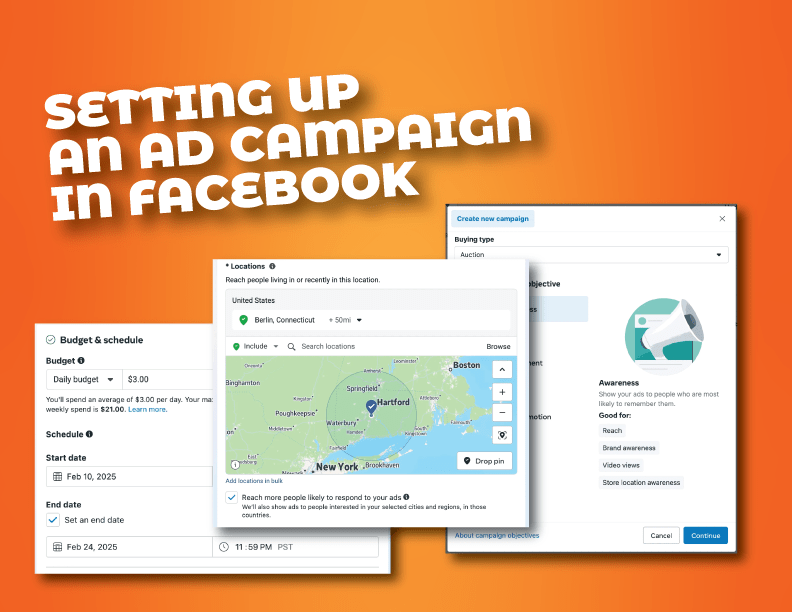
I have a confession to make: I’m a social media manager who’s never set up an ad campaign.
Shocking, I know. I’ve never had the opportunity to set one up. But it’s important to be able to spread a brand’s message at scale. According to Faris Yakob in Paid Attention, “In a world of infinite content, actions created at scale can become content engines. Do things in the world, then tell people.” Ad campaigns on social media can help to reach people at scale. That’s why this week, I practiced my ad campaigns abilities in Facebook Ads Manager by setting up a hypothetical campaign.
Currently, I work as the social media manager/content creator for TSSG, which is a company that coaches and provides digital software for generator dealers. This is a very specific and unique audience, consisting mainly of individuals between 35-55.
TSSG has yet to run ad campaigns, as we focus heavily on organic content. However, expanding our strategy with paid social would be able to generate more success for the brand on social. According to Claire Beveridge for Semrush, “Organic posts help promote your business. But they can take time to build up views and engagement… In contrast, paid advertising can instantly get your business and its message out to your target audience.” For this reason, I need to learn how to set up an ad campaign through Facebook Ads Manager.
For this ad campaign, I’ll focus on TSSG’s Digital Products — a collection of software that allows dealerships to automate sales faster and more efficiently. The ad placement will be solely on Facebook, which sees the highest engagement from our audience. Given that we’ve had success with the platform when it comes to organic social, I have a hunch that it would also be the most effective for a paid strategy.
Awareness
In Facebook Ads Manager, I start by selecting a buying type of “Auction” and a campaign objective of “Awareness.” The main objective of the campaign is to drive awareness about the company and its products. As a young business, it is crucial to reach potential customers who don’t know about us yet. I’m not necessarily worried about generating engagement for sales, but rather, getting the word out to dealers about what TSSG is and how it can potentially help them.

My ad doesn’t fall within any special ad categories, so I leave this section blank. I also choose to leave the A/B test section blank as well, as I will only be running a simple ad to dip our toes into the water and see how we do.

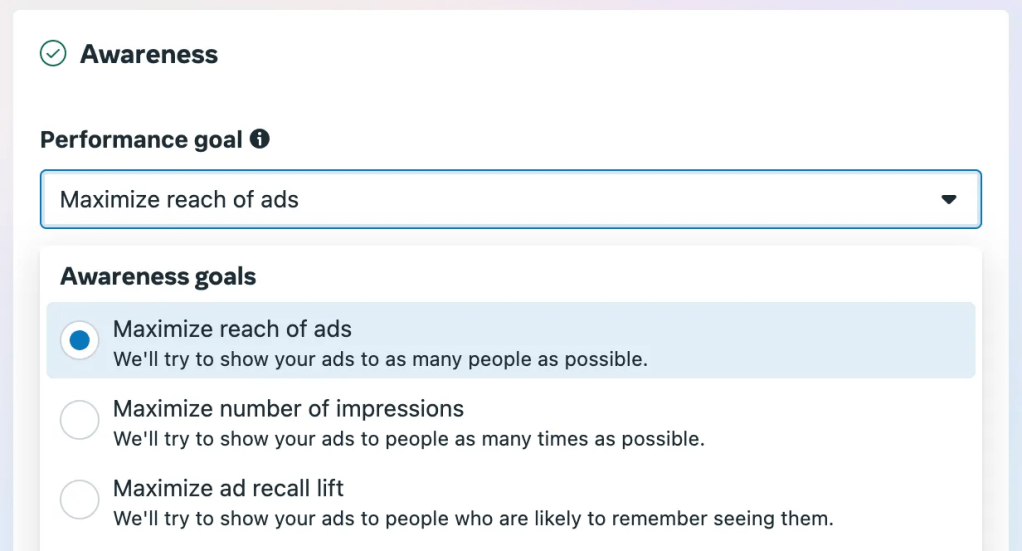
The next set of questions have to do with awareness. There are three goals to choose from for awareness (keeping in mind that the ad is a graphic and not a video).
- Maximize Reach of Ad: The ad is seen by “as many people as possible”
- Maximize Number of Impressions: The same people see the same ad multiple times
- Maximize Ad Recall Lift: Facebook finds people “who are likely to remember seeing [the ad]”
Because the idea behind this campaign is to spread the word about TSSG to our target audience, I select “Maximize Reach of Ad.” I want a large number of individuals to see this ad, so that they’ll have a chance to learn more about who we are.
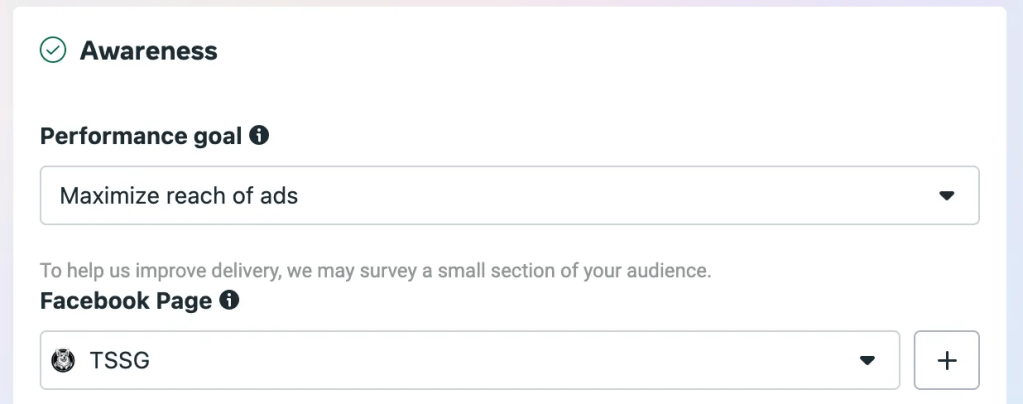
Then, I make sure to select TSSG as the Facebook page that will run that ad.
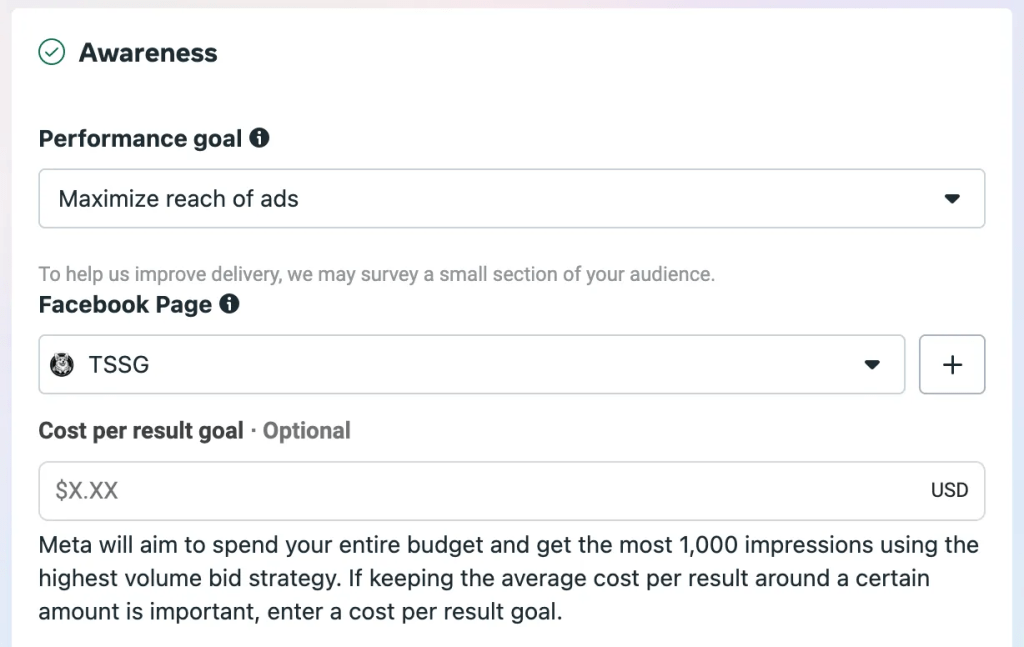
I skip the Cost Per Result goal, as this optional field does not relate to our goals for this campaign. Instead, I want to pay a single sum (daily budget) and see where that gets us.
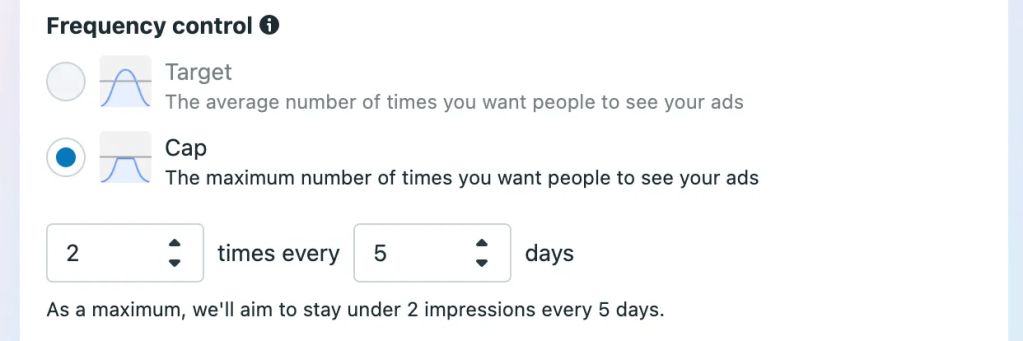
Frequency
The next field has to do with how often a user will see the ad in a certain amount of days. The default was set to twice a week (2 impressions every 7 days). However, I want this ad to be more visible to people without being overly annoying. I don’t want to raise the number of times, because people might become annoyed if they see the same ad over and over in a short period of days. Instead, I lower the days to 5. This way, the ad will be seen a bit more often (under the stipulation that the campaign runs for more than 5 days), but won’t be overpowering or annoying.
Budgeting
In choosing the daily budget for the campaign, I have to take into account the potential for conversions. This is because running an ad campaign, at the end of the day, should deliver some sort of ROI for the business. Since a purchase at TSSG is definitely upwards of $1,000, as long as one purchase could be generated from the campaign, and I spend under $1,000 on this, we’d be good in terms of generating a positive ROI. Luckily, I shouldn’t have to put a large number for the daily budget — one article I found from the Sachs Marketing Group recommends between $1-5 daily, but other articles, such as one from Vertex Marketing Agency, recommends between $10-30 a day.
Since I’m conflicted, I think about how this is our first ad campaign, and the fact that we don’t know exactly how it will go. So, I go on the safer end and decide $10 a day should be good. I also decide that we’ll run this campaign for a two week period, bringing the total cost to $140. Not too bad, so long as we can get one sale from this!
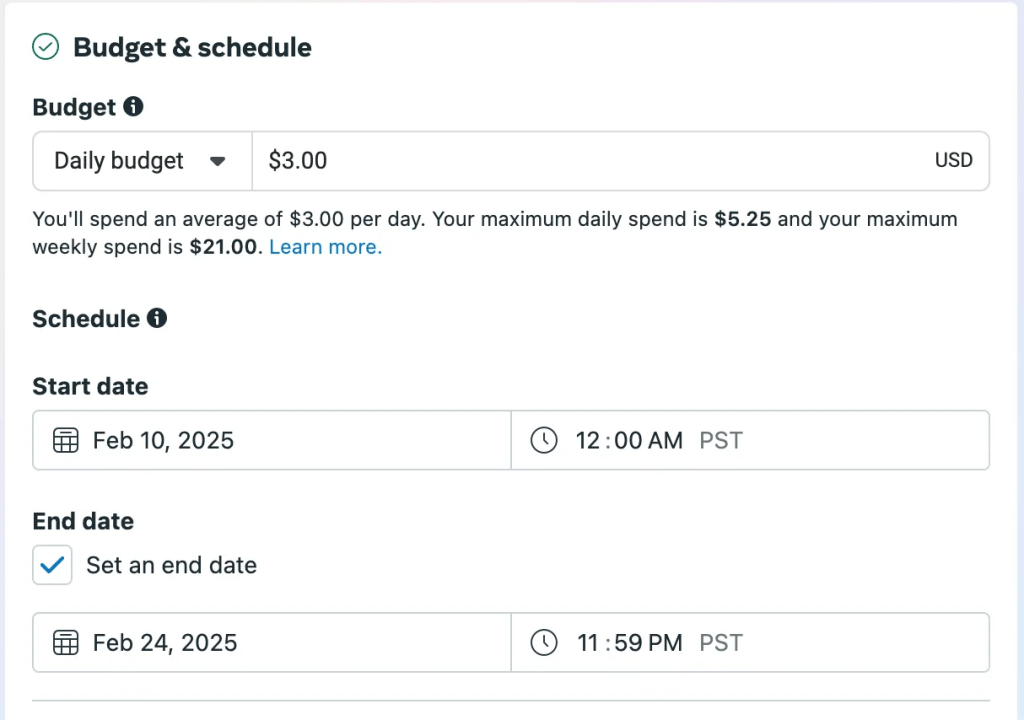
I also decide not to increase the budget during the time period. I feel like the solid $10 a day should be good enough for this basic campaign. This box is left unchecked.

Targeting
Targeting the right audience is essential when it comes to any ad campaign. According to Sharon Lee Thony in The Marketing Campaign Playbook, “Understanding who you’re targeting is crucial.” In creating the segment for this campaign, I referred to some of the insights I found last week in Sprout Social to inform my choices. This includes the fact that our general audience consists of 35-55 year olds.
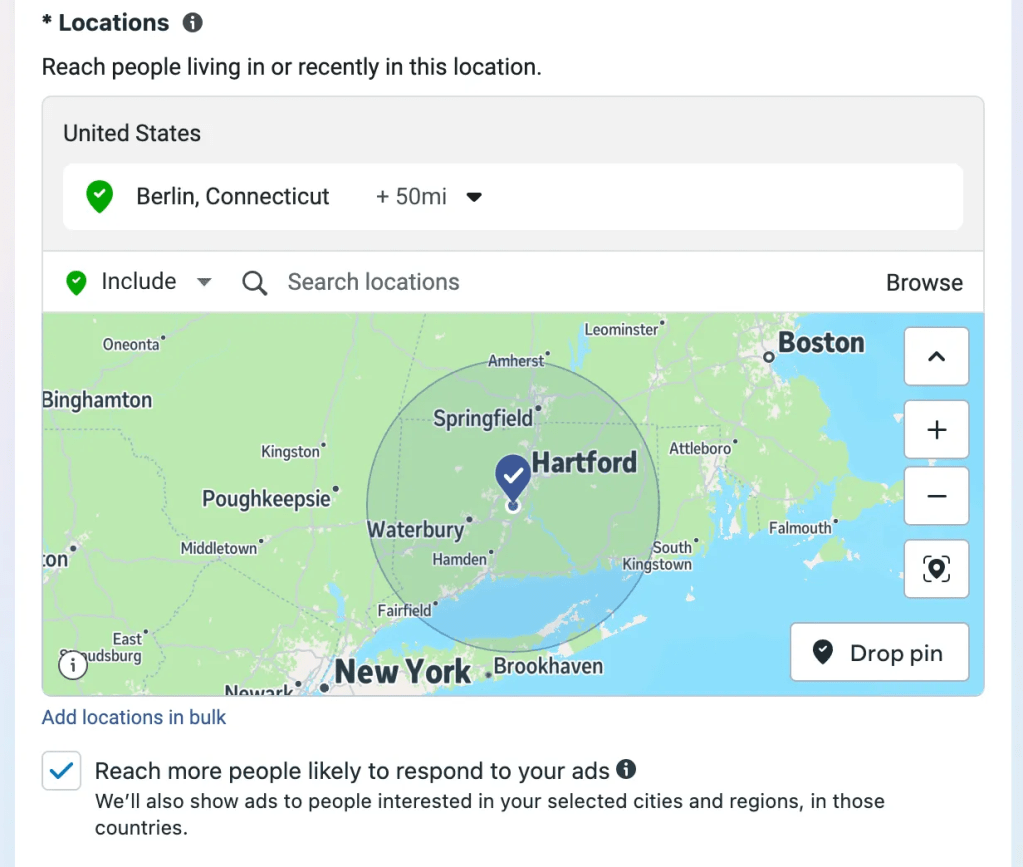
TSSG in located in Berlin, CT, although the company has clients all over the country. But in my mind, why not start local? It could help to build more relationships with other generator dealerships in the area, especially since we’re a younger business. Plus, if the ad does well here, we can later expand it to other areas of the country with the knowledge that the success could potentially translate. With this idea in mind, I set out target to a 50 mile radius around Berlin, which encompasses almost the entire state of Connecticut, and includes small areas of Massachusetts and New York. And, of course I’d like to “reach more people likely to respond to your ads.” Isn’t that the point? Leave this one checked, please.
After dealing with location, I then start to target age. Since our target audience is 35-55 year olds, I set this to be the age range for the campaign. Gender is not important here – people of all genders work in the generator industry. I do, however, have to do some detailed targeting, to make sure this ad gets to the right people. An ad about generator dealer software won’t do much if it is seen by people who don’t even work in the industry. For interests, I target “sales,” “electric generator,” “HVAC,” and “electricity generation.” Finally, I check the box for “Advantage detailed targeting,” since it may be helpful for Facebook to expand upon this targeted audience if it means the ad could potentially perform better.

Creative
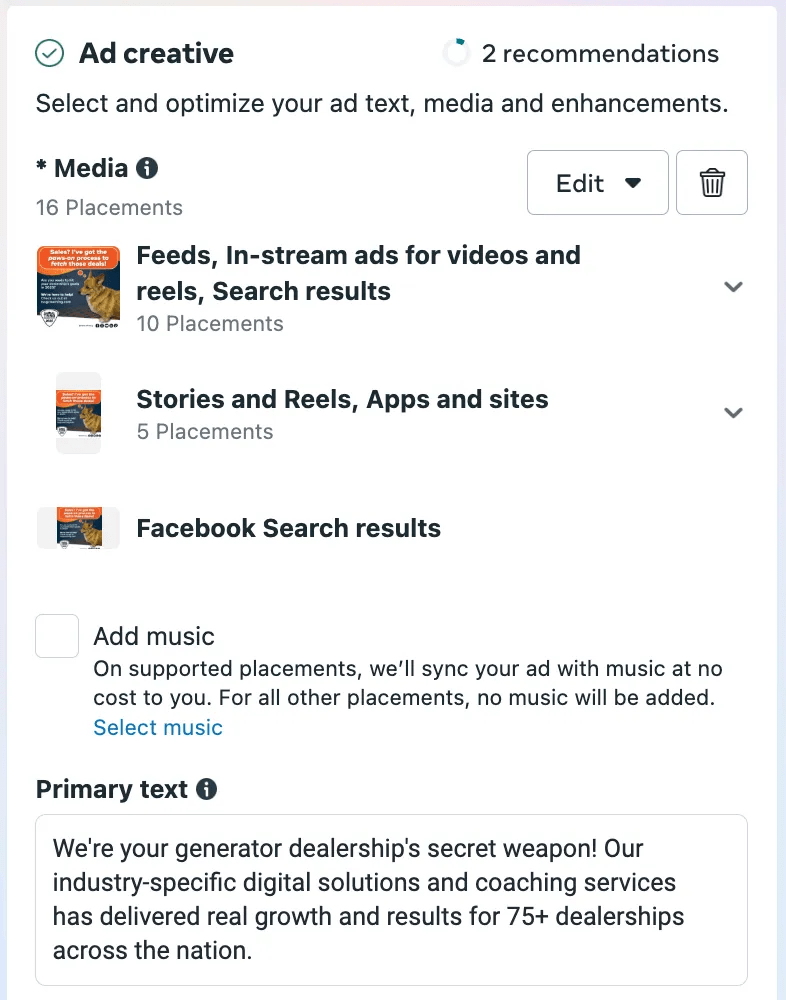
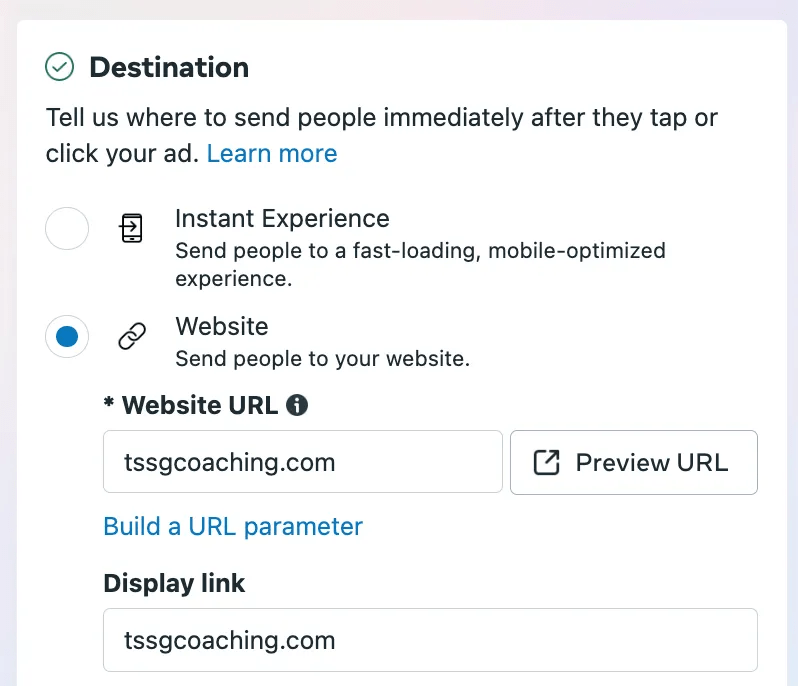
I then set the creative for the ad, as well as the link I want the “Learn More” CTA to drive to. It looks like I’ll have to create a version of the ad that will fit for stories and reels, too.
Metrics for Success
The main metrics to track the success of this campaign will be CPC (Cost Per Click) and ROI. The lower the CPC, the better the campaign is performing. Alongside this, ROI would be a key metric. My main concern, when it comes to calculating ROI, would be to make sure that any conversion can be accurately traced back to the ad campaign. According to Olivier Blanchard in Social Media ROI, “Tying a social media program to the P&L is simply a matter of understanding the relationship between each milestone along this conversion path and measuring them properly. ‘Simply’ in theory. In practice, though, it’s not difficult to measure; it’s difficult tom prove.” Any conversions have to be accurately traced to the campaign, and this would involve looking for any “spikes” in conversions after the launch date of the campaign.
Conclusion
Although setting up this ad campaign was just for practice, it gave me a lot of key insights. The first being that a lot goes into setting up an ad campaign than meets the eye. The hardest part for me was the targeting section – I had to think very strategically as to where the ad would run, and how to select details that would get the ad to the right audience. However, in reviewing the final selections I made for this campaign, I believe it would be effective should it be run, as the choices made are in-line with the brand’s overall social media strategy.
References
Beveridge, C. (2024, January 29). Paid Social Media Advertising: A Beginner’s Guide. Semrush Blog. https://www.semrush.com/blog/paid-social/Blanchard, O. (2011b). Social Media ROI. Pearson Education.
Faris Yakob. (2015). Paid Attention. Kogan Page Publishers.
How Your Budget Affects Your Facebook Ad Campaign Structure. (n.d.). Vertex Marketing Agency. https://vertexmarketingagency.com/how-budget-affects-facebook-ad-campaign/
Sachs, E. (n.d.). How Much Should You Spend on Facebook Ads? Sachs Marketing Group; Sachs Marketing Group. https://sachsmarketinggroup.com/how-much-should-you-spend-on-facebook-ads/
Thony, S. L. (2024). The Marketing Campaign Playbook. STK MKT Entertainment.

 Perfectly Imperfect
Leave a comment