Last week, I did an analysis of 7 Brew – a chain of coffee stands that is quickly growing – and their paid social efforts. In this article, I’ll look into a different strategy 7 Brew could use to grow on social: influencer marketing.
When I think of coffee and influencers, I think of the most New England brand anyone could ever think of: Dunkin’. From their collaboration with TikTok star Charli D’Amelio, to their 2024 Super Bowl “DunKings” commercial with Ben Affleck, Tom Brady, and Matt Damon, to their recent collaboration with Sabrina Carpenter.
Ok – maybe I only named one actual social media influencer there. But you get the point.
The brand continually uses influential people as a way to promote the chain. And influencer marketing on social media makes use of this effective strategy. Influential people, with high views and engagement rates, create content surrounding your product with the hope of generating conversions and positive ROI for your brand.
According to Olivier Blanchard in Social Media ROI, “The more ‘human’ and colloquial the conversations and content, the more effective they are.” Leveraging influencers provides brands with the opportunity to be more human, relatable, and personable, while harnessing the reach of the influencer’s established audience.
7 Brew is a fast-growing chain of coffee stands, with over 200 locations in the US. They are different from other coffee chains because they are drive-thru only, and have a strong focus on community. Aside from the typical assortments of coffee and teas, 7 Brew also has a line of energy drinks and smoothies. The brand can best be described as energetic – and their social profiles reflect thus.
7 Brew has very engaging content and an energetic social presence. But they have yet to embrace the full opportunity of influencer marketing in the strategy. There are moments in the past that the brand has worked with influencers – but it was only for a short period of time. Once, they had a collaboration post with an Olympian.
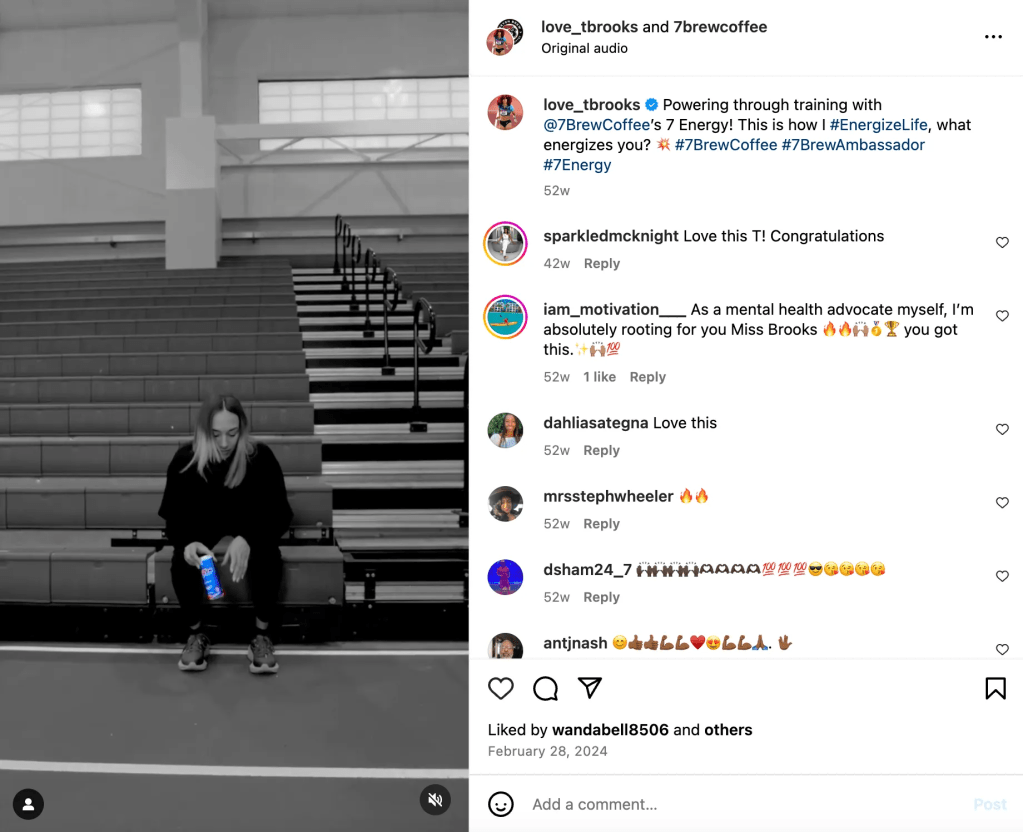
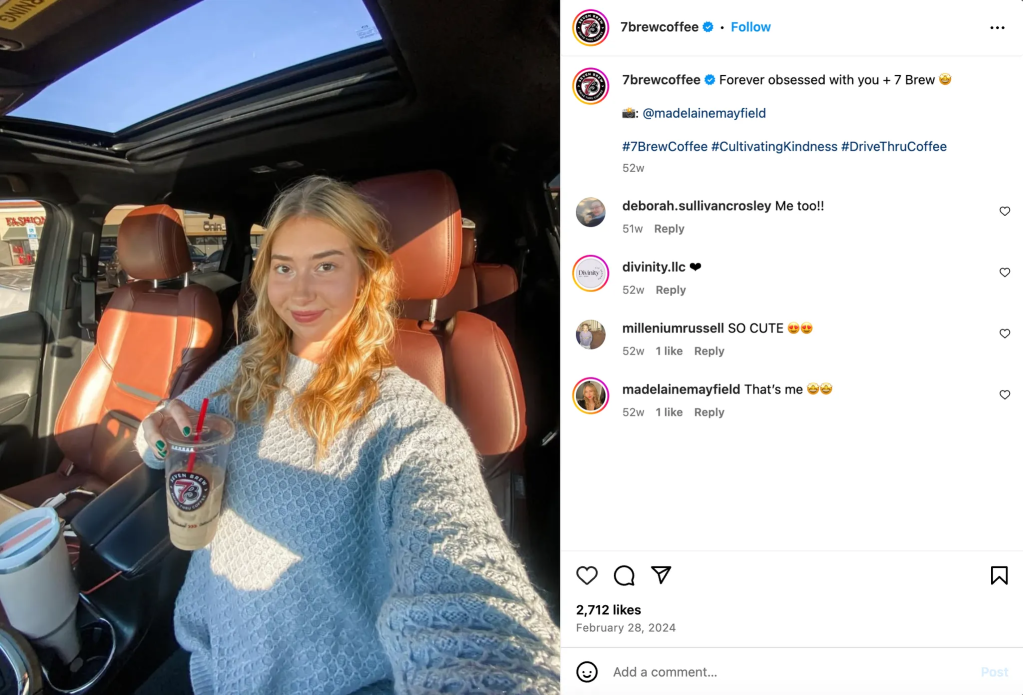
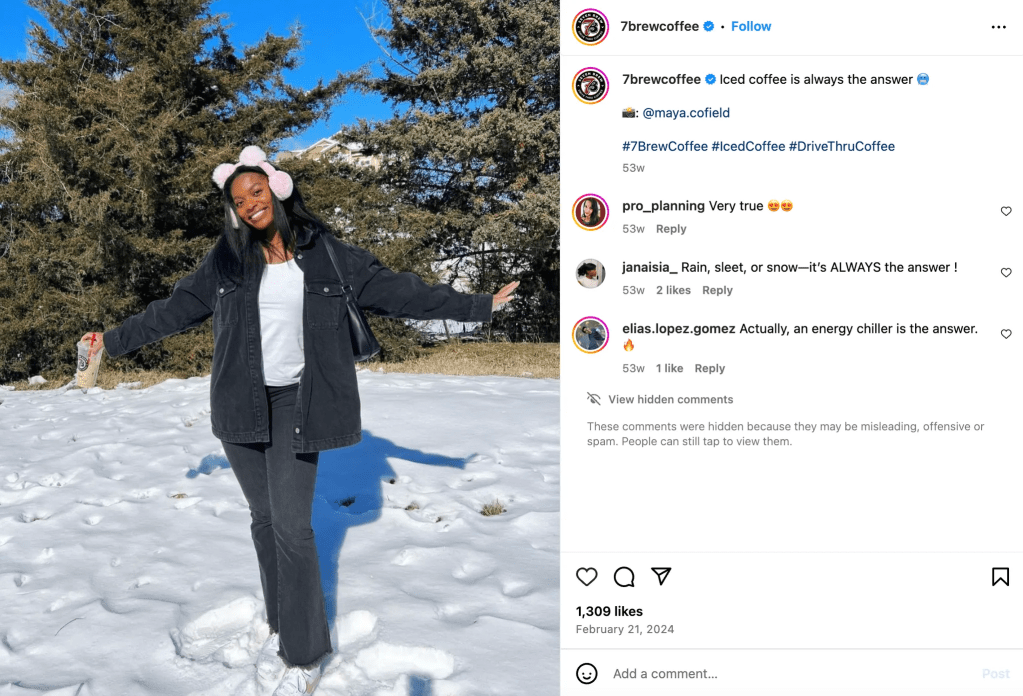
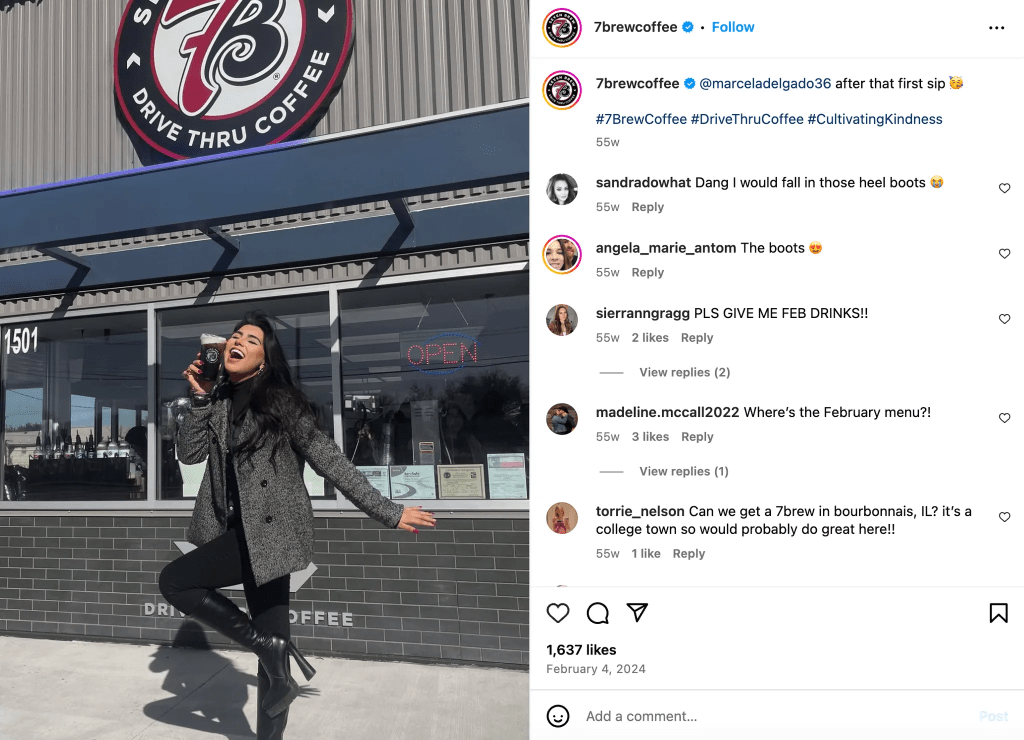
However, the brand doesn’t appear to have done any influencer posts since February 2024. Considering that the brand is growing, 7 Brew should expand their social strategy and take advantage of the opportunity to use influencer marketing.
Strategy Outline
The main goal of 7 Brew’s influencer strategy would be to increase local awareness of the brand. Thus, reach would be the primary concern of this campaign. As part of this strategy, we would leverage sponsored posts and affiliate marketing. Since the aim of this campaign is reach, we need to maximize the opportunity to showcase the brand to the unreached users who are already followers of these influencers. That way, we can expand the reach out our brand’s messaging to new people.
Since we’re focusing on reaching certain geographic segments, the influencers we will use for the campaign should be individuals from those areas. According to Sharon Lee Thony in The Marketing Campaign Playbook, brand should “Work with influencers to create content that feels authentic and resonates with their audience.” The type of content can be either photos or videos of them stopping by a 7 Brew stand near them. Along with this, since the focus is local, each influencer could mention the stand that they got their coffee from. The addition of this local element will resonate with the geographic segment, as it will make the brand stand out from other “generic” affiliate posts.
Performance Measurement
The KPI’s for this campaign will be focused around the engagement rate on influencer posts, views/impressions, and CPM. Our aim is mainly concerned with reach, not necessarily on conversions (although the campaign will result in some conversions). Many of these metrics will be tracked using Facebook Ads Manager, Instagram Insights, and TikTok One.
Influencer Selection
A quick glance at 7 Brew’s location map shows that most locations are in the northeast, the south, and the midwest, with few in the west. When it comes to running paid ads, 7 Brew tends to create custom audiences to run area-specific ads to geographic segments of their audience. Similarly, because 7 Brew is located in certain geographic areas of the US, it would make sense to find nano and micro-influencers that cater to the target audience in those specific areas.
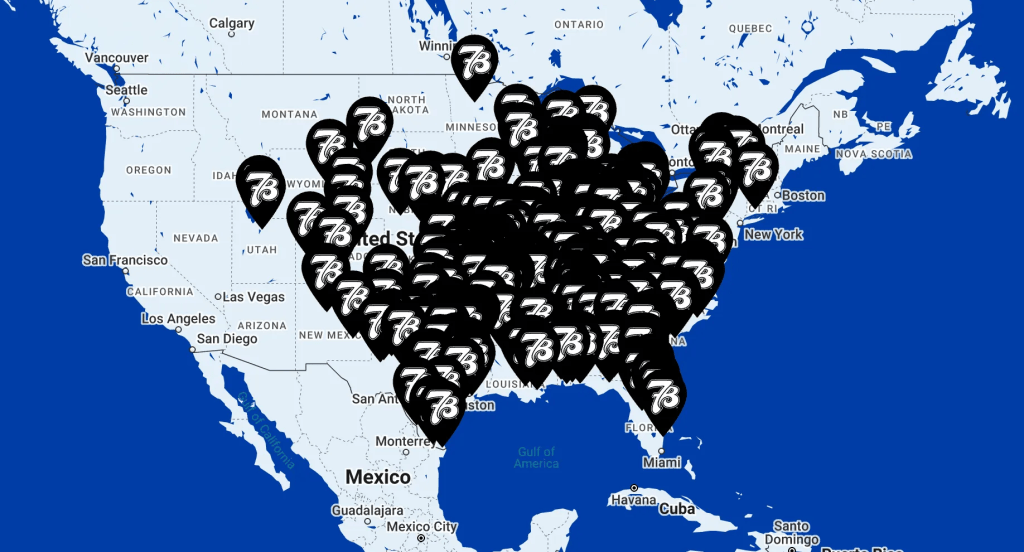
Considering that 7 Brew is somewhat of an “underdog” compared to more established brands such as Dunkin’s and Starbucks, it would not be as fruitful to recruit a macro or mega-influencer. Influencer Marketing Hub’s 2025 Report documents an overall shift to nano and micro-influencer due to economic challenges, as well as effectiveness, stating that “while nano-influencers excel at fostering niche engagement, mega-influencers are better suited for large-scale awareness campaigns.” 7 Brew tends to focus on their community aspect, which makes niche creators a perfect choice for the brand. And, since 7 Brew is still growing, we can infer that the budget is somewhat limited – meaning that smaller influencers would be the best way to go.
For the sake of this example, let’s look for nano and micro-influencers that can cater to 7 Brew’s geographic segment in South Carolina, where the brand currently has (ironically enough) 7 stands.
A quick influencer search brings up a lot of lifestyle influencers based around the Charleston, South Carolina area. One influencer I found was Hannah Elise, a creator from Charleston who creates a lot of lifestyle-based content that appeals to a younger demographic. This lifestyle content also includes trips to coffee shops.
The thing that stands out to me about Hannah is that her TikTok engagement rate, according to hype auditor, stands at a high 10.05%. Though she is technically classified as an Instagram macro-influencer with 130k followers on Instagram, she only has around 92.4k on TikTok, which would make her ideal for a 7 Brew collaboration on the platform.
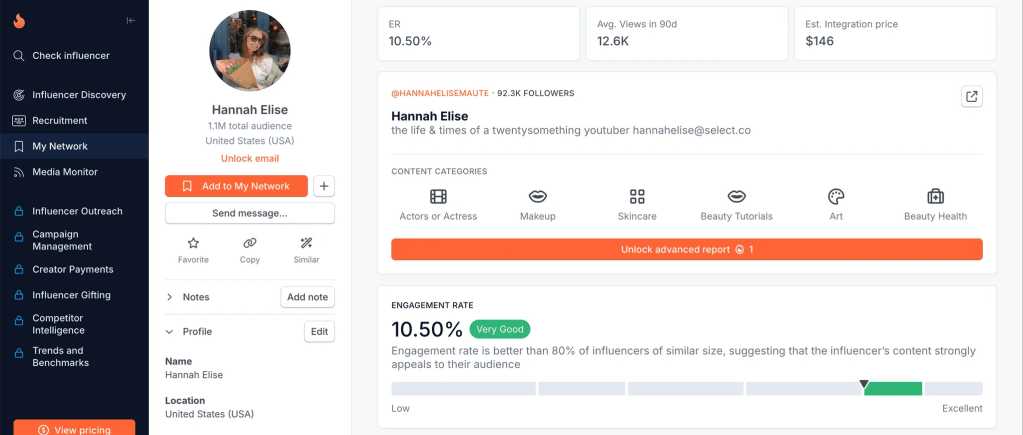
Unfortunately, since I only have the free version of HypeAuditor, it capped my limit after this search and a couple after. It did show me that found one creator, who had around 8k followers on Instagram, had an engagement rate of a mere 1% – making her a poor fit of a choice.
However, I was able to find some other South Carolina-based creators on Instagram who post lifestyle content – frequently including coffee – that would be a great fit for 7 Brew. One of them, Louis, make a blog all about different places and stops in the area, and is a micro-influencer with 12.9k followers.
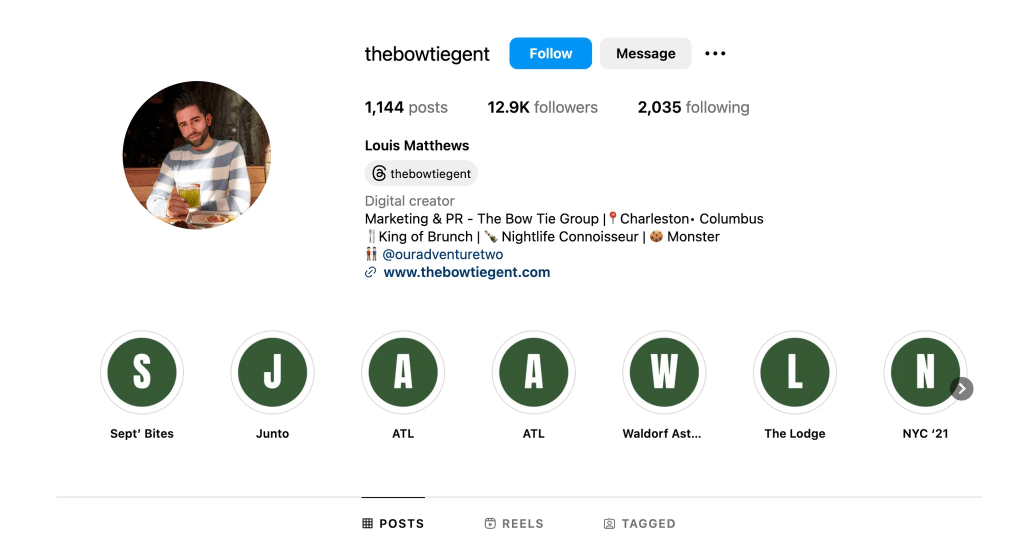
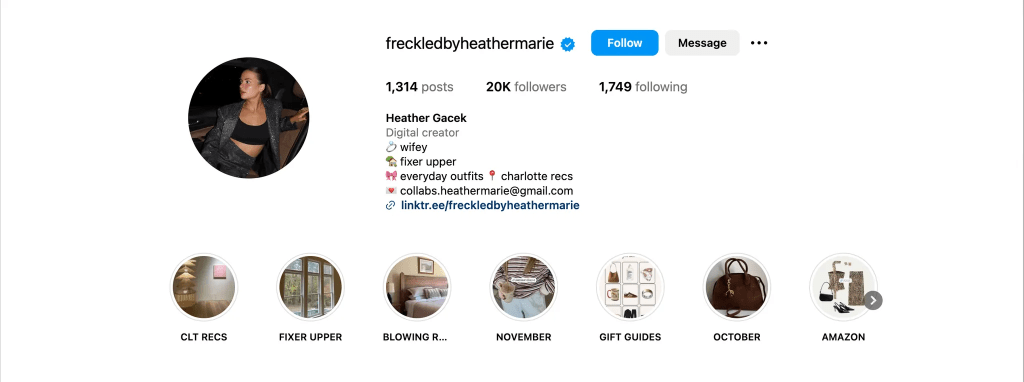
One creator that I think would be a perfect influencer for 7 Brew to use is a lifestyle influencer named Heather with 20k followers. Although I can’t see her engagement rate through hype Auditor, her most recent post garnered 11k likes, which is quite impressive.
Challenges and Solutions
One potential challenge in creating a regionally-based influencer strategy is that there might not be an ideal “influencer pool” in each area. For example, a quick search for New York related influencers who post coffee content didn’t bring much to the table. In situations like these, it may be best not to run an influencer strategy in the area, and to focus on paid social ads instead to maximize the budget.
Another challenge is that some locations are the only one in their state (ex. Wallingford, CT), and it wouldn’t make sense to create a localized strategy. However, a localized strategy could still be created by using a nano-influencer or influential individual within the town.
References
7 Brew Drive-thru Coffee. (n.d.). 7 Brew. https://7brew.com/
Blanchard, O. (2011a). Social Media ROI. Pearson Education.
Influencer Marketing Hub. (2024, September 16). The state of influencer marketing 2024: Benchmark report. Influencer Marketing Hub. https://influencermarketinghub.com/influencer-marketing-benchmark-report/
Thony, S. L. (2024). The Marketing Campaign Playbook. STK MKT Entertainment.

 Perfectly Imperfect
Leave a comment