If you know me, you know I’m a coffee lover. That’s why when 7 Brew opened in my town, I instantly became a fan.
7 Brew is a little-known coffee stand franchise that sells an assortment of coffee and energy drinks. As of December 2024, it was reported that the fast-growing chain has over 300 stands across the nation. 7 Brew’s concept is different from other chains like Dunkin’ and Starbucks because they don’t have indoor seating: the stands are drive-thru only, and they blast loud music.
This week, I’m going to be examining 7 Brew’s audience – more specifically, as it relates to audience segmentation.
Target Audience
Who is 7 Brew actually targeting? From a brief look at 7 Brew’s Instagram page, you’ll see colorful graphics and photos — all of them being “trendy” and bright. You’ll see memes alongside more candid and polished photos. Although 7 Brew isn’t “edgy” like Wendy’s or Duolingo, they aren’t as formal as Starbucks or other traditional chains. They fall right into the middle.

The company’s C-Suite confirms some of my suspicions. According to a Forbes article by Gary Stern in 2023, 7 Brew CFO Nicole Miller Reagan was quoted as saying that the audience includes “the early night shift nurse who loves black coffee and the college student looking for a study time pick-me-up from an energy drink or flavorful coffee.”
Here are my observations:
- Demographics: Younger individuals ages 18-35 (Gen Z and Millennials). Any gender or education.
- Behaviors: These individuals live fast-paced lives, and desire convenience.
- Interests: Interested in pop culture. Also, social proof — they desire to find belonging and know what’s “in.”
- Location: Primarily in the Northeast, Midwest and South, where stands are located.
Segmentation
Segmentation allows brands to craft messaging, based on research, which appeals to specific types of people. According to Sharon Lee Thony in The Marketing Campaign Playbook, “Segmenting your audience allows you to tailor your marketing messages to reach group more effectively.” We can break this audience down into a variety of potential segments, and create ads that would resonate with each segment.
- Geographic Segmentation: In the past, I’ve seen ads targeted towards me for a 7 Brew stand opening in my town. This means that 7 Brew already targets a small/local radius around their stands. This can also be expanded to target states and regions (for example, targeting the northeast audience vs the southern audience).
- Demographic Segmentation: 7 Brew can specifically target the Gen Z and the Millennial audiences separately.
- Behavioral Segmentation: We can segment the audience into college students, young professionals (recent college grads in various occupations), and also millennials.
- Psychographic Segmentation: We can specifically target individuals within the audience who have interests in different things. For example, we can create ads for the chain that would resonate with fans of a particular sport or a celebrity. This can open up the doors to influencer partnerships (ex. Charli D’Amelio and Dunkin) which can lead to more visibility and conversions for 7 Brew.
Custom Audiences
7 Brew can use retargeting in order to show its ads to a specific segment of the audience that has already interacted with them via their social media platforms.
For example, based on a strategy shared by Jamie Stenton in a YouTube video, we can create a custom audience based on users that have visited the 7 Brew Facebook page within the past 90 days, and create another segment with people who interacted within the past 30 days. The days matter here – an ad can be created to reinforce a product to use who recently interacted with the account, whereas a different ad can be created to reinforce the brand and keep it in the memory of those who interacted with it a little while back.
We can also create a target audience around users who have visited the 7 Brew website in general, and segments that visit a certain page. Anyone who hops onto the website can be placed into a custom audience, in which ads would be shown to reinforce the brand after their visit. A different audience could also be made based on a visit to a specific location page alone. In this example, people who visited the 7 Brew location page for the Wallingford, CT stand can be placed in a custom audience, with an ad campaign more tailored to the specific area.
Custom audience are a great way to retarget existing customers, with the potential of increase frequency and yield of purchases.
Lookalike Audience
In any scenario, lookalike audiences have the potential to increase reach for a brand. Aside from their primary audience, 7 Brew can further expand their audience by creating a lookalike audience. This can be generated by using existing information that has been gathered about customers, such as sign-ups for the company’s loyalty program. Ideally, this would include demographic information, from which Meta Ad Manager can create a lookalike audience from. That way, Ad Manager would be working from a great source and can find users who are similar to the existing target audience base.
Creating lookalike audience would allow 7 Brew to reach new users who fit within the target audience, but have yet to interact with the brand. An effective use of lookalike audiences could include targeting similar users to those who follow or interact with the social pages of 7 Brew’s competitors (I should also note that this could also be used as a custom audience strategy, where ads could be served to those exact users). For example, based on a strategy shared by Derek Videll in his YouTube video, we can gather the account information of a brand’s followers, and upload that into Meta Ad Manager in order to target ads specifically to people similar to them. Let’s say this competitor brand is Chamberlain Coffee – which could perhaps be popular with the segment of in 7 Brew’s target audience who are a fan of both pop culture and influencers. We could look through Chamberlain Coffee’s follower list and then create a lookalike (or custom, depending on the goal) audience based on this information.
Analysis
In analyzing the brand’s current advertising efforts on Meta platforms, 7 Brew shows great effectiveness in creating ads that resonate with their target audience. A quick search for the brand in Meta Ad Library will show a variety of campaigns which 7 Brew is currently running.
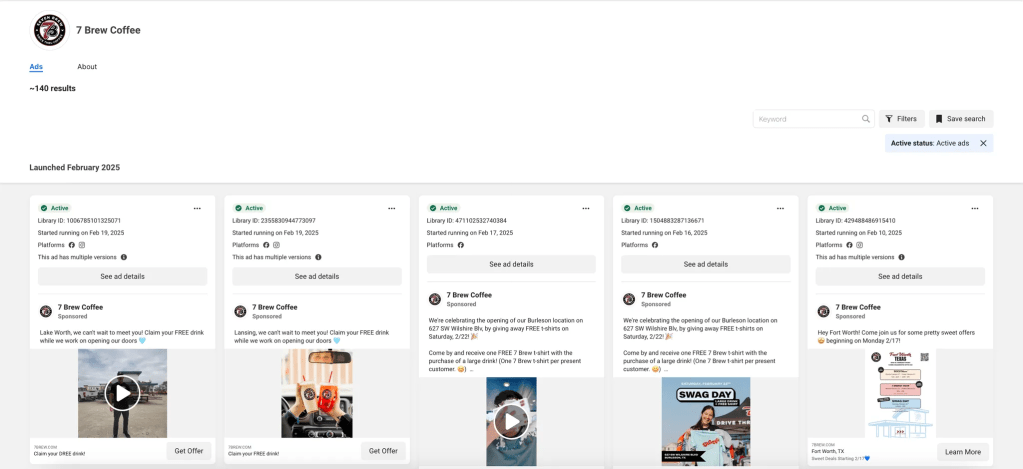
Segmentation is important because it allows brands to make ads which truly resonate with social media users. An ad which stands out to one segment of the audience might not be as effective with another segment. For example, an ad about a coffee pick-me-up from your busy day in class will resonate with college students, but it won’t with an older segment that has already graduated college (or did not go to college) and could relate better with a long day at work.
Secondly, audience segmentation has a strong correlation to the topic of FRY shared by Olivier Blanchard in his book Social Media ROI. Segmentation allows brands to not only reach potential customers through lookalike audiences (reach), but also encourage a higher frequency or yield of purchase from existing customers with custom audiences. The audience can be segmented to create groups that relate to the brand’s ROI goals.
Nike consistently uses segmentation successfully in their various ad campaigns. For example, in 2024, Nike launched the “Winning Isn’t for Everyone” campaign. The campaign used various athletes, and this is something to note – different athletes will resonate with different segments of Nike’s audience. Basketball fans will be drawn to LeBron James, while tennis fans will resonate with the fact that Serena Williams is in the campaign. The interesting thing, however, is that the campaign has two parts: the TV spot and a feature film with different athletes. While the TV spot would cater to a more general audience of customers, the feature film more likely reaches the segment of die-hard Nike “fans,” potentially aimed at reinforcing brand loyalty in the midst of Nike’s current issues in the market.
As a growing brand, 7 Brew has a lot of opportunity to reach new audiences as they continue their expansion. If they continue to focus on creating effective segments through both custom and lookalike audiences, 7 Brew can potentially increase their ROI through paid social media campaigns.
References
Blanchard, O. (2011a). Social Media ROI. Pearson Education.
Derek Videll. (2024, April 3). How to Use Facebook Custom Audiences to Target ANYONE. YouTube. https://www.youtube.com/watch?v=E2nRYjmCv0E
Jamie Stenton – Digital Marketing Expert. (2024, September 18). Complete Guide to Custom Audiences for Facebook Ads! Everything you need to know! YouTube. https://www.youtube.com/watch?v=q8-P1FrQ6WA
Nike. (2024, August 26). Great Athletes Remind the World There’s Nothing Wrong with Wanting to Win. Nike.com. https://about.nike.com/en/newsroom/releases/winning-isnt-for-everyone-campaign
Stern, G. (2023, November 8). 7 Brew Finding Success With Drive-Thru Only And Franchising. Forbes. https://www.forbes.com/sites/garystern/2023/11/08/7-brew-finding-success-with-drive-thru-only-and-franchising/
Thony, S. L. (2024). The Marketing Campaign Playbook. STK MKT Entertainment.

 Perfectly Imperfect
Leave a comment