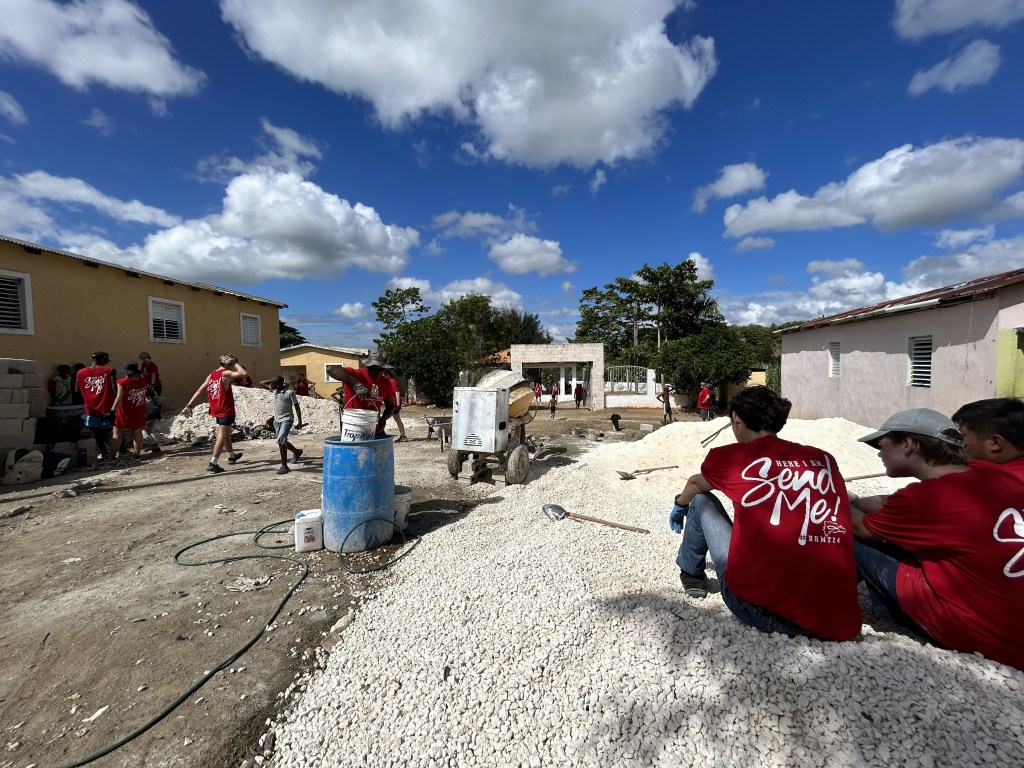
Last January, I went on a missions team to La Romana, Dominican Republic. It was the annual winter trip of the Dominican Republic Missions Team (DRMT), which is located in my hometown of Wallingford, CT. Since the 90s, the DRMT has traveled to the Dominican Republic to serve undocumented Haitian sugarcane workers through a variety of medical, construction, and food distribution related projects organized by a local missionary church in La Romana. This week (and next) I’m on a mission to create a brief documentary about the DRMT, and what makes it special.
Reading
This week, I read chapters 7 and 9 of The Bare Bones Camera Course for Film and Video by Tom Schroeppel. Chapter 7 discusses the various different types of lights that can be used while filming, and goes over a basic lighting setup. Chapter 9 gives a general overview of preparing to film, and goes over storyboards as well as setting up a planning document.
Schroeppel introduces three different types of lights for filming. “Three basic types of lights, using tungsten quartz halogen bulbs,” writes Schroeppel, “are traditionally used in interior lighting: focusing quartz, broads, and softlights.” A focusing quartz is reminiscent of a spotlight, with a focus that can either be very small (spot) or wide (flood). Broads, more or less, are exactly what they sound like – they “put out a broad even light over a large area,” as Schroeppel puts it. Soft lights are the circular ones typically used in photography that bounce off a surface; the downside being they don’t offer much in terms of adjustment.
After reading this information, I immediately questioned the necessity of having so many lights. The answer has to do with shadows – the subject needs to be well-lit – and I realized this after reading about a basic lighting setup. According to Schroeppel, this includes the fill light, key light, background light, and backlight. My second question was why a backlight would be necessary. Besides, the camera wouldn’t be pointed at the subject’s back, right? According to Schroeppel, the background light “[creates] a rim of light which visually separates [the subject] from the background.” My personal takeaway is that in filming a video, a lot has to be done with lighting in order to (1) ensure the subject is visible, (2) add depth to the subject, and (3) get less shadows. Although it seems like a lot of lights, the end result makes the subject clearer – and this is what is needed in any video.
For my documentary project, I am making use of what I have in terms of lighting. Without professional lighting equipment, I will be using a lamp and a ring light (the lesson here is to account for Amazon delays). Although not the most ideal, these lights share a similarity to a broad light, in that it will shine over a large area. I’ll also be making use of natural light, although it definitely is not the most ideal lighting choice due to the movement of the sun.
In chapter 9, the concept of shooting out of sequence is discussed. Schroeppel gives an example in which different scenes have to be shot at a certain location. In this case, you can just take all those shots at one time, instead of going in shot order and having to go back and set up in the same location. ‘For some sequences, especially those involving a lot of lighting changes, there are advantages to shooting the scenes out of sequence – out of order” writes Schroeppel. This is just pure logic: the viewer doesn’t know the order you shot the video in, nor do they care. They just see what you allow them to see.
Schroppel writes a fantastic note on communication. “I believe in communicating. I try to let everybody, from my assistants to the people who will appear on camera, know what we’re going to do.” I completely understand where Schroeppel is coming from. Personally, I overcommunicate whenever I lead a team, and I have found this practice to be effective. Overcommunication is something I was taught by a mentor. In a leadership role, I can never assume that people know what I’m talking about, especially if it’s the first time I’m going over something.
Research to Inform
In preparation to record this documentary, I did some research to find videos that I found to be well produced – and also provide a hint of creative inspiration.
The first video comes from D&AD, a professional design association located in the UK. It is a feature of Sean Areoye, a creative who is a part of a D&AD program. This video presents Areoye’s story and also his thoughts on the program.
This feature uses a lot of close ups of Areoye, and uses fast transitions and zooms for creative effect. There is the use of motion graphics in the various text overlays that pop up; images are also animated throughout to keep up with the fast-pace of the video. Although we hear Areoye as a voice over, we don’t actually see shots of him speaking.
What truly stands out to me in this video, however, is the use of color, which has been adjusted to be very vibrant, albeit saturated. The lighting used on Areoye during his close up shots also allow for the creation of shadows (see 0:21), which also contribute to the inspirational creativity of this piece.
You know you’re adulting when you suddenly find yourself interested in watching videos of random people’s homes. Although I’m a content creator, I am only mildly aware of influencers such as Emma Chamberlain. However, this Architectural Digest video of Chamberlain’s home somehow made its way to my recommended page, and I ended up watching the whole thing.
This video uses a lot of camera movement to showcase elements inside the home. There are also a lot of pans and movements that start from a low angle, and then move up. One interesting transition used throughout the video is a moving “split screen” where two different shows are shown on opposite sides of the screen (see 0:09-0:15 for a good example of this). Other than this, there’s not a ton of fancy edits, giving the video a simplistic and modern feel.
The final video I found while researching is an interview with graphic designer Paula Scher. Although Scher is regarded as one of the best graphic designers today, this video unfortunately doesn’t match in terms of quality. The video is good overall because the shots are well-composed, and there are flawless transitions between the shots of Scher to shots of her work. There are also well-composed shots of Scher during this interview using a multi-cam setup.
However, the video becomes ineffective in that the audio has a ton of background noise. Other videos in the channel do use background noise, making for a stylistic choice. But in this specific video, the environment of the interview is echoey, and the noise created as a result is a cause of distraction. This could be easily fixed with a denoise effect if edited on Adobe Premiere Pro. Additionally, a multi-cam set-up was used for the interviews, however, the color is not consistent in both shots (compare the color of the two shots from 1:48-1:52 and you will see a noticeable difference).
Create
This week, I created a planning document to outline all my ideas for the project, which you can view here:
After this, I got to the fun part – conducting interviews and filming with the participants. Check out some of the unedited footage below:
Note: Audio was recorded on a separate mic, which still has to be aligned with the video files.

 Perfectly Imperfect
Leave a comment