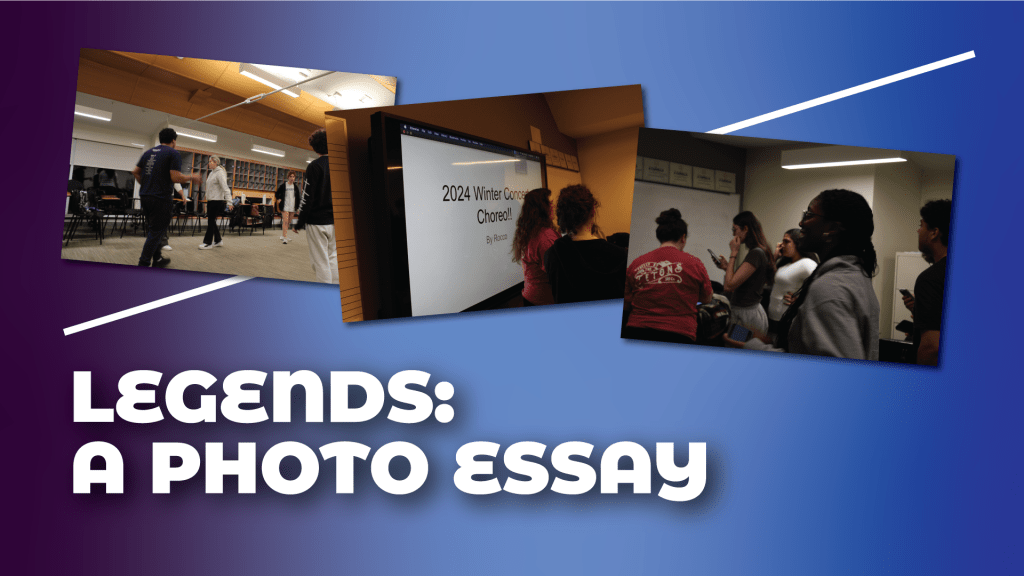
This is my fourth and final year in The Legends A Cappella. It is the only a cappella group at Quinnipiac University – but that description alone doesn’t describe everything the group is.
It is said that the group was established in 2012; however, documentation from the university’s student-run newspaper, The Quinnipiac Chronicle, reports on the group’s existence one month before that year, in December of 2011. It is said to have been formed after a student watched the then-popular hit show, “Glee,” and having been inspired, started a Facebook group petitioning to start Quinnipiac’s very own glee club.
In a 2011 Quinnipiac Chronicle article, Michelle Gearrity reports on the group’s initial beginnings in struggling to recruit members. “Students around campus were asked if they had heard of the QU Legends. The majority didn’t know who they were or that the university even had a glee club. However, when the word spread of a potential Quinnipiac Glee club last December, many students expressed a strong interest.” Somewhere along the line, The Legends transitioned from being a glee club to an a cappella group. A hint of this is also present in the article, which writes that “The club is currently working on its own a cappella version of Maroon 5’s ‘Moves Like Jagger.’”
Since those beginning days, The Legends has since placed to be amongst the top of other collegiate a cappella groups nationally. With every year of auditions, a large number of students audition for the group, with only a couple being accepted. Every year, The Legends competes at the International Championship of Collegiate A Cappella (ICCA); and in previous years, has competed against groups from major music schools.
Every winter, The Legends prepares for its annual winter concert. The concert and the rehearsals leading up to it, not only allows the group to share their talents with the public, but also implement and practice techniques that they will use during the high-stakes ICCA season in the Spring. In essence, this is the pre-season. The following photos are from the group’s first choreography rehearsal of the year, in preparation for the Spring Concert. The photos were taken on Thursday, November 21, 2024.
The Theme: A transparent and unfiltered look into the “room where it happens,” as the award-winning The Legends A Cappella group prepares for its annual winter concert.
Sing, Sing, Sing

While waiting for other members of the group to arrive at the off-campus music building, some members of the group start to practice a song. With the desks having been moved to the sides of the room to make space for the choreography rehearsal, these members decide to stand and move around as they sing with other members of the group.
Tea Time
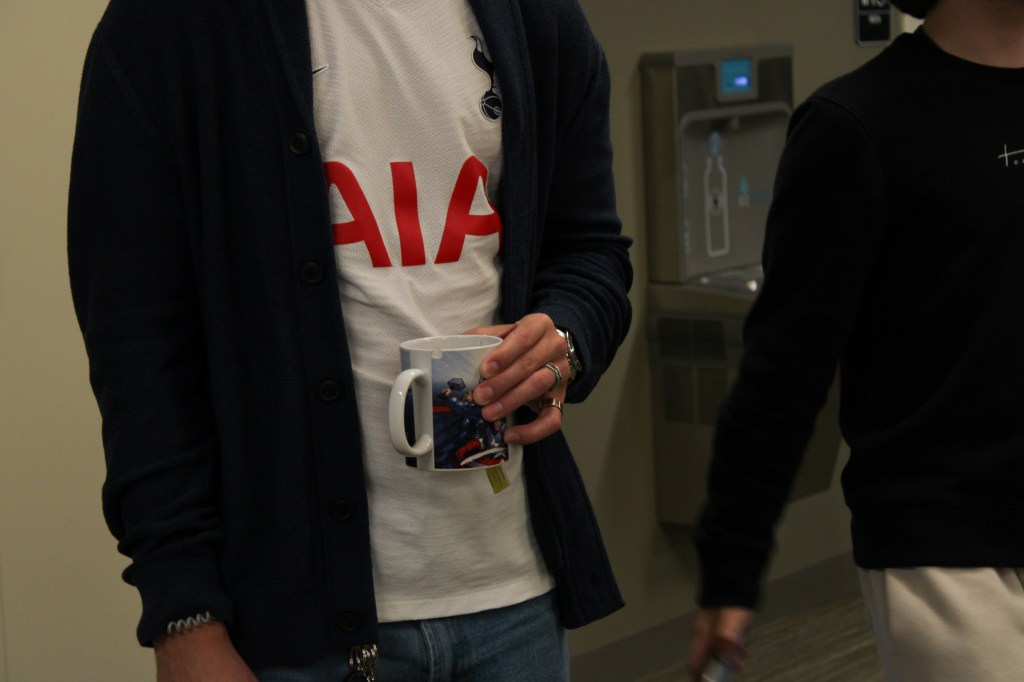
Rocco arrives at the rehearsal with a Marvel-themed mug in his hand. Because of the late-night rehearsal time, it is also common for members to bring snacks – even meals – to rehearsals. Less common, however, is the bringing of a cup of tea, but this choice makes sense given the cold and rain of this particular November evening.
Warming Up

After everyone settles in and announcements have been given, the vocal warm-ups begin, allowing members to refocus their minds and voices after the long school day. Following the warm-ups, The Legends begin to do what they do best: that is, sing.
In this shot, we see two members of the group looking for their sheet music on a phone. Although the group does print out copies of music, many members now decide to look at virtual copies, either on their tablets, laptops, or phones.
A Lesson In Movement

In this picture, Rocco, the performance coordinator, demonstrates a specific hand motion that will be used in one of the songs. The choreography for all of the group’s performances is created by the Performance Coordinator. It is also the responsibility of the PC to thereby teach the choreo.
Although a cappella focuses predominantly on musical sound, it also incorporates motion and movement, especially in a competition setting. However, it is always integral that the choreographed motions add to – essentially, compliment – the music, and never serve as a distraction from the musical element.
The Soloist
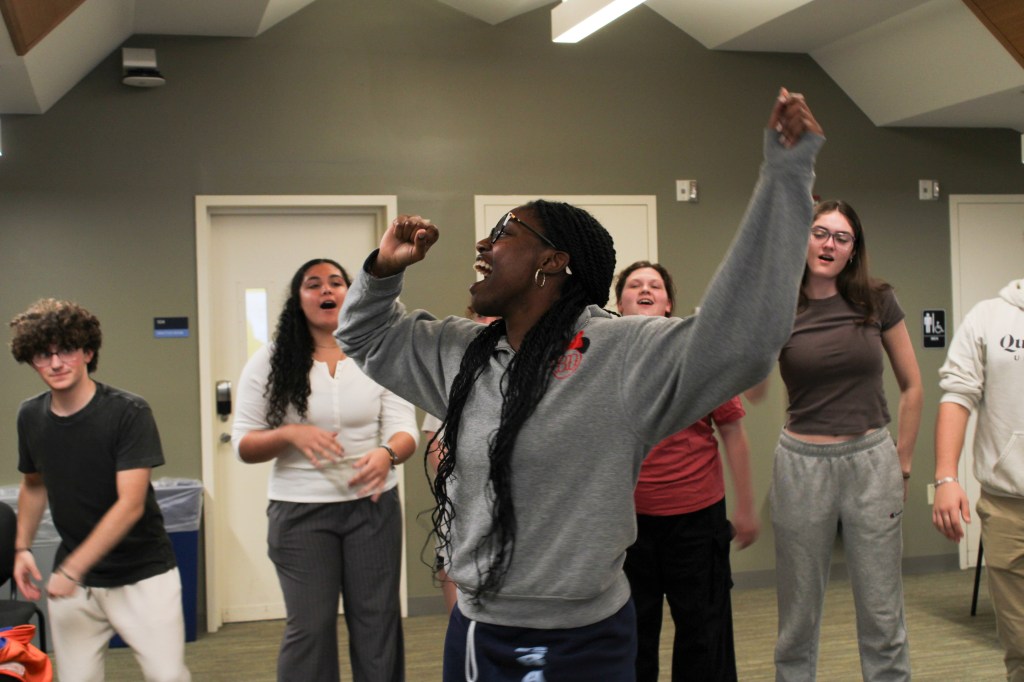
In almost every a cappella song, there is a soloist who sings the melody. (Sometimes, there is a duet, in which two soloists share the melodic line and eventually harmonize later in the song.)
For this particular song, the soloist is Stephanie, shown prominently in the center. Surrounded by her are other members of the group in an “arc,” a typical formation used by a cappella groups and other musical ensembles alike.
Breaktime

Every rehearsal is two hours long, but it’s common to have a break somewhere along the way. Legends either chat in groups, play the piano, or just simply check their phone like Noah is doing in this photo. On this particular night, the break leans towards the longer side.
Working It Out

Choreography involves a lot of different formations and motions. In this specific formation, The Legends are scattered around in an X while looking towards the center. This is a unique formation – one that is new to the group – and it is sure to be perplexing from the audiences’ view.
Until We Meet Again
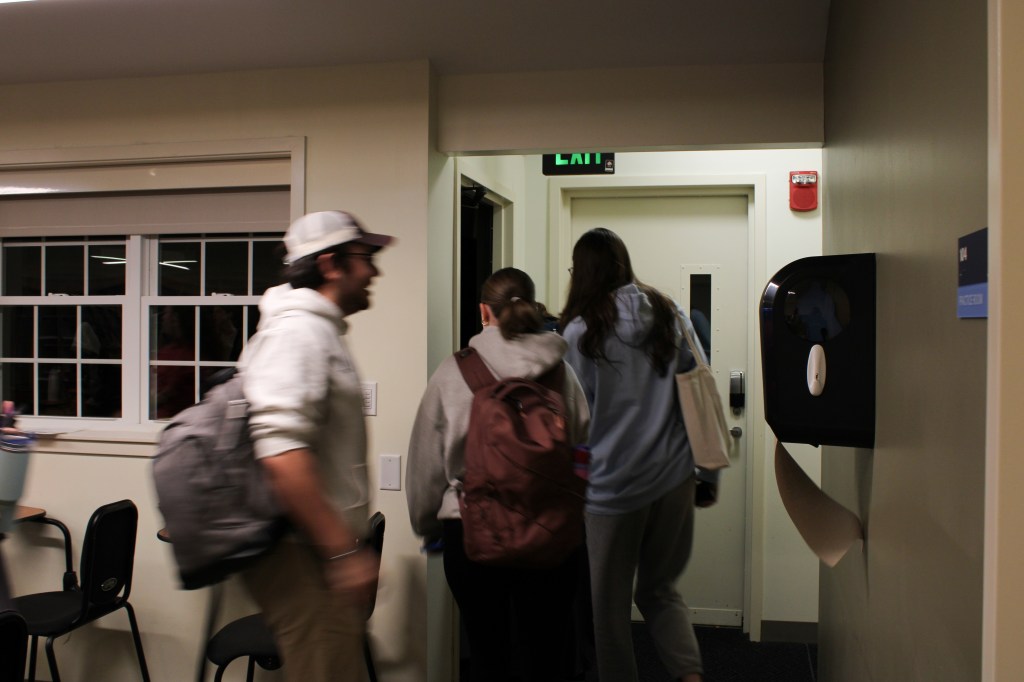
After the long rehearsal, The Legends make their way out of the music building a little after 11:30pm. Since this rehearsal takes place before Thanksgiving break, the group won’t have their next rehearsal until they return a week later. Members wish each other a happy Thanksgiving as they make their way towards the door.
Rationale
Since the rehearsals are limited solely to the group’s members, this photo essay attempts to showcase what the typical a cappella rehearsal experience is like. The central goal is to give the viewer an accurate experience of the rehearsal through a still lens. In an article for Harvard Business Review, B. Joseph Pine II and James H. Gilmore write about the connection piece of experiences, writing, “The second dimension of experience describes the connection, or environmental relationship, that unites customers with the event or performance.” This essay attempts to bridge this connection between the distant viewer and the closed-door a cappella rehearsal.
Because of this focus on providing an experience, my photos can be categorized as authentic candids. In an article for Amplifi, Mike Montalto highlights the concept of authenticity in storytelling, writing that “candid visuals are the best way to reveal the reality of your work and your story.” To make the photos authentic, I focused on showing what is before my own eyes.
In compiling this photo essay, I thought of it as a storyboard; one crafted by experience rather than imagination. “The purpose of a storyboard is to explain action with a concise series of pictures,” writes Ellen Lupton in her book, Design Is Storytelling. In the same way that a storyboard tells a story in a series of images, a photo essay documents the beginning, middle, and ending stages of a narrative arc set in an actual reality.
In the case of this rehearsal, we begin with the Legends warming-up. The climactic point is the soloist passionately singing, with the members smiling around her. We then end with the members leaving for the night. In between, there are moments of practicing and learning – a challenge in itself to develop, with the penalty of not performing well. To an extent, it makes use of the 3-act story structure shared by Tim Stout in his blog post about producing comic strips. Indeed, a photo essay shares obvious similarities with a comic strip.
Additionally, Lupton writes that “To construct a storyboard, designers plan the arc of a narrative and decide how to summarize the story in a limited number of frames.” This is similar to the process of narrowing down photos for the photo essay, which proved to be equally as difficult as taking the pictures. I had to focus on selecting only a couple shots from a wide variety to best fit the storyline of the true rehearsal experience. Certain details had to be touched on in a limited amount of photos to meet this goal. For example, if an image from the warm-up was not incorporated, viewers would be left with an inauthentic understanding of the rehearsal, as the warm-up is an essential part of the event.
It is in this sense, however, that this particular essay meets a certain weakness. In a Medium article, Eman Shurbaji writes that “In a photo essay… the pictures support what’s in the text, but a person can understand the topic without having to read text or captions.” Although the essay attempts to meet this guideline, it proved to be a difficult challenge. I am not entirely sure that some of the shots can give the viewer an accurate understanding without the written context.
Instead, this photo essay aligns itself more closely with the concept of WED (writing/editing/design), which was originally conceived by Roy Peter Clark and Mario Garcia. In creating this essay, I used WED as a central mindset/technique in crafting the final product. According to Ron Reason in an article for Poynter, WED “refers to the harmonious marriage of Writing, Editing and Design to produce a journalistic project that is more powerful than any one element in isolation.” The essay makes use of photos and text, and makes sure that both align to tell the story of a typical a cappella rehearsal. “No longer are photos and videos an appendix, running independent of the text,” writes Garcia in his own blog post about the concept. “Readers like the fact that there is one single unit of thought.” Indeed, this photo essay combined the written and visual aspect to depict a single storyline. The captions and photos are used as a compliment to each other, giving readers a full understanding of the context in which each shot takes place.
Works Cited
(Module 5) Eman Shurbaji. “Photo Narratives.” Medium, Ideas: Journalism + Tech, 17 Dec. 2014, medium.com/learning-journalism-tech/photo-narratives-d77b812f99dd.
(Module 5) Garcia, Mario. “Digital Storytelling, Part One: The Fusion of Writing/Editing/Design.” García Media, 19 Jan. 2017, garciamedia.com/blog/digital_storytelling_part_one_the_fusion_of_writing_editing_design/.
Gearrity, Michelle. “QU Legends’ Membership Hits Low Note .” The Quinnipiac Chronicle, 6 Dec. 2011, quchronicle.com/17948/arts-and-life/qu-legends%E2%80%99-membership-hits-low-note/.
(Module 2) Lupton, Ellen. Design Is Storytelling. New York, Ny, Cooper Hewitt, Smithsonian Design Museum, 2017.
(Module 1) Montalto, Mike. “The Four Principles of Visual Storytelling.” Amplifi, Amplifi, 25 Jan. 2024, amplifinp.com/blog/4-principles-visual-storytelling/.
(Module 3) Pine, B. Joseph, and James Gilmore. “Welcome to the Experience Economy.” Harvard Business Review, Harvard Business School Publishing, 1998, hbr.org/1998/07/welcome-to-the-experience-economy.
“Quinnipiac Legends Shine with Award-Winning Performance.” Qu.edu, Quinnipiac University, 6 Feb. 2024, http://www.qu.edu/quinnipiac-today/quinnipiac-legends-shine-with-award-winning-performance-2024-02-06/.
(Module 5) Reason, Ron. “WED: The Integration of Writing/Editing/Design.” Poynter, Poynter Institute, 19 Aug. 2002, http://www.poynter.org/archive/2002/wed-the-integration-of-writingeditingdesign/.
(Module 2) Stout, Tim. “How to Use 3-Act Story Structure in Comic Strips.” Tim Stout, 3 Sept. 2011, timstout.wordpress.com/2011/09/03/how-to-use-3-act-story-structure-in-comic-strips/.

 Perfectly Imperfect
Leave a comment