Pictures talk. When you look at a picture, you hear as much as you see. Pictures freeze moments in time, serving as reminders of the things of the past. In essence, pictures can tell stories as much as your talkative best friend can.
I remember getting a Flip video camera in elementary school for Christmas. It was a weird camera in general, and its success was short-lived. Structured as a thick white rectangular prism, it eventually broke when I accidentally hit it on the floor. The Flip camera was my first foray into the use of the camera, a couple years before everyone suddenly seemed to have a smartphone with a camera in their pocket.
The photo galleries on our phones store thousands of stories. And if “a picture is worth a thousand words,” then we carry millions upon millions of words in our pockets every single day.
Aside from this, we also constantly scroll on social media feeds, which show us more images – a good fraction coming from brands seeking to advertise to us – multiplying those words we carry into the billions, or even trillions. And then, on our morning commutes, we pass by more stories on billboards. We walk past stories plastered on posters, flip through the images in magazines, and watch more advertisements on TV and YouTube. According to the University of Southern California, “people see roughly 5,000 ads per day. There are 5.3 trillion display ads shown online every year. On average, children see 20,000 thirty-second commercials each year. Adults see an average of 2 million of those on a yearly basis.”
So for this blog post, I have chosen to examine images of advertisements – some captured on camera and others captured with the camera. Because if images can tell a story, and marketing also tells stories, then the two go hand-in-hand.
McDonalds

https://www.linkedin.com/posts/gavinshoebridge_mcdonalds-looks-like-its-gone-from-a-happy-activity-7190791275132952577-vgBX/
Story: A transition from cultural character to corporate homogeneity.
Okay – I will admit a photo of a building itself isn’t an ad. But, in a way, it kind of is.
McDonald’s is one of corporate America’s most notable brands. Growing up, McDonald’s was a fun place, with a red roof, large golden arches in the front, and a colorful playground. In short, the building – outdated as it may have been – had a sense of character.
Fast forward, however, to the 2010s, when the company renovated many of their buildings to be more modern. Dark gray and brown became the new colors of the facade, and the angled roof made way for a flat rectangular structure.
According to Seth Gitner in Multimedia Storytelling for Visual Communicators in a Multiplatform World, “Color plays a very large part in the mood and meaning of an image… Color can be lush, balanced, and pleasing, or it can be harsh and discordant. It can also be muted and pale, or warm, or cold.” This is an accurate depiction, in the case of McDonalds – what once had a welcoming color has now switched to becoming cold and somewhat distant.
The move from being happily playful to just downright boring is fueled by capitalism. According to an article by Steven T. Wright for Vox, “The muted colors, large glass windows, and overall boxy appearance of a modern McDonald’s are forgettable, and a far cry from the garish red-and-yellow buildings that many recall from their childhood. Slowly but surely, fast food restaurants are giving up their once brand-defining facades to follow in the path of ‘fast casual’ eateries like Chipotle, which have become much more popular over the years.”
This picture has since been memed multiple times. I remember reading a post once that said something along the lines of McDonald’s having graduated from Sunday school to youth group. Other people turn the change into a comment on either capitalism or the loss of culture, highlighting the impressive architecture of structures which came before. Regardless, this “before and after” image tells a story about the state of our society.

FTX

https://www.cnn.com/2022/11/11/investing/ftx-larry-david-commercial/index.html
Story: This skeptic is actually right for once.
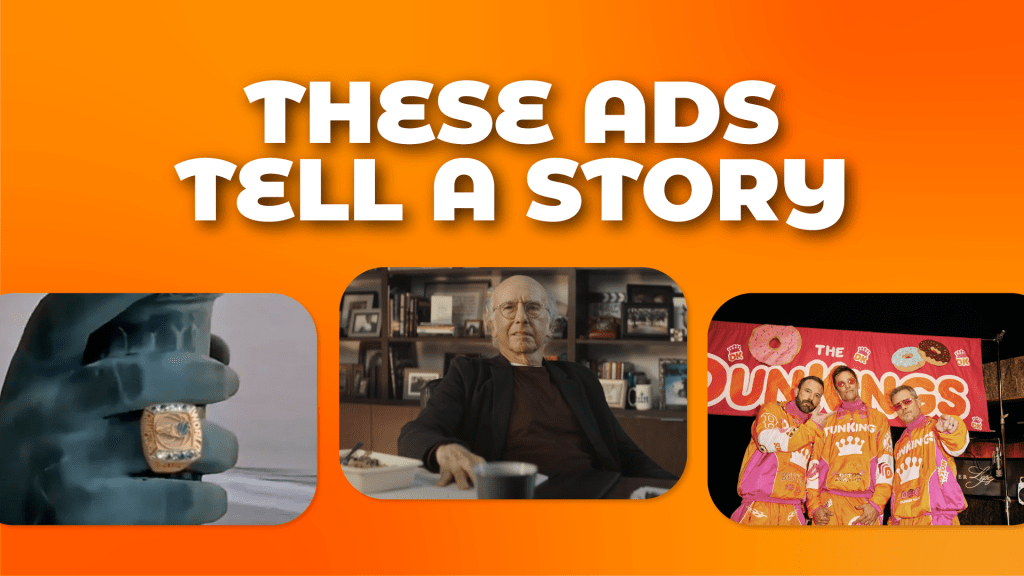
In 2022, comedian Larry David (known for his roles in HBO’s “Curb Your Enthusiasm” and for his SNL parody of Sen. Bernie Sanders) appeared in a Super Bowl commercial for cryptocurrency exchange FTX. Throughout the commercial, the viewer sees David in a variety of scenes throughout human history – the invention of the wheel, Edison’s invention of the lightbulb, and even the advent of portable music. In every single moment, David shows hesitance and pessimism, saying that the new creation – each one now known for having revolutionized society – would never work.
This brings us to the moment of this particular scene, with Larry David sitting across from a guy trying to convince him about cryptocurrency – and more specifically, FTX. With skepticism in his face, David once again says no, adding “I’m never wrong about this stuff.” The point of the commercial was that Larry was wrong: FTX would be the next big thing, and he would miss out on the revolution once again.
But in this case, Larry David was actually right. FTX soon crumbled as around $8 billion of other people’s money was lost on what has been called one of the worst financial failures in history. According to CNN, John J. Ray III, who took over FTX as CEO to investigate its collapse, stated in a court filing that “Never in my career have I seen such a complete failure of corporate controls and such a complete absence of trustworthy financial information as occurred here.” Sam Bankman-Fried, the once-praised FTX founder and CEO turned money laundering criminal, was convicted on seven counts of fraud, according to an article by Jordan Freiman for CBS News.
Larry David, sitting at this desk and stating his disapproval, is a distinct moment in the commercial, and in the FTX storyline. According to Seth Gitner in Multimedia Storytelling for Digital Communicators in a Multiplatform World, “A moment is exactly what it sounds like: a very short bit of time. But it is a very important bit. It is the instant when an event is crystallized, when its significance is packed into a fleeting incident, expression, or gesture.” Although this moment was made to comment on FTX as being revolutionary, it eventually came to represent irony, as the pessimistic man becomes right for once. Since the fall of FTX, people have commented on the commercial’s deep irony, using this distinct moment as a representation.
Nike x WNBA

https://uproxx.com/dimemag/nike-ad-celebrate-new-york-liberty-wnba-title-video/
Story: Lady Liberty Gets a Ring
Quite recently, the New York Liberty – a professional WNBA team – won the league’s 2024 championship. This year in particular was monumental for the WNBA, which according to a press release, was “its most-watched regular season in 24 years, finished with its highest attendance in 22 years and set records for digital consumption and merchandise sales in 2024.” After five games, New York won the series 3-2, giving them their first WNBA title.
Soon after the big win, Nike posted a reel on its Instagram page, featuring the Statue of Liberty with a championship ring on its finger – a fitting tribute to a historical win. It makes the connection to the Liberty team earning a ring, and the Statue of Liberty as a representative of New York City as a whole. In just a couple seconds, the video is able to encapsulate the whole story of a monumental WNBA season with the NY Liberty championship.
The advertisement is a great example of relevance in storytelling. “The stories your images and videos tell need to feel relevant for your audience to make that emotional connection,” writes Mike Montalto in a blog post for Amplifi. “This helps turn your story into more than an anecdote.” In this specific instance, Nike’s release of the video was timely, and struck an emotional chord with fans and New Yorkers.
KFC

https://75media.co.uk/blog/iconic-advertising-campaigns/
Story: A chicken restaurant chicken’s out.
What happens when Kentucky Fried Chicken has no chicken? This scenario happened in Europe back in 2018 due to travel delays. According to Richard Priday for Wired UK, this led KFC to shut down some of their locations. “KFCs started to shut down locations in response to their missing ingredients… only 266 of the 870 restaurants in the UK and Ireland were open.”
Instead of passing the blame, KFC took things into their own hands. They published a full-page ad in the newspaper with an apology. It featured an empty KFC bucket with the letters scrambled to more closely represent an expletive; one that appropriately represented a reaction to the debacle.
In this image, KFC tells a story of frustration. Their buckets are empty, and they sympathize with people’s anger. CNN’s Alanna Petroff wrote that “The cheeky apology was well received.”
The empty bucket, in a way, also serves as a visualization of the situation: KFC has no chicken. According to Andrew Losowsky in his writing on Visual Storytelling, “A successful visualisation is the same as any successful story, regardless of medium.” This ad’s success can be attributed both to its illustration and timeliness.
Dunkin‘

https://news.dunkindonuts.com/news/dunkin-dunkings-super-bowl-commercial-2024
Story: High-attaining Bostonians reaching for unattainable dreams.
Ben Affleck, Matt Damon, and Tom Brady are all names synonymous with Boston. So it’s only fitting that Dunkin’ – a brand that is also distinctly tied to the city – would choose these three individuals to form a boyband in their 2024 Super Bowl commercial. In this commercial, Ben Affleck interrupts his then-wife Jennifer Lopez in the recording studio to show off what he believes is the next big thing in music: The DunKings. The boyband, however, is met with an unfavorable reaction, with them having to leave the studio.
The story itself makes use of using the senses to keep the audience engaged. According to Mike Montalto for Amplifi, “disrupting the norm with something that overwhelms the senses can trigger someone to act.” Even from just this image itself, the bright colored suits using Dunkin’ branded colors, coupled with the silliness of three famous individuals wearing the horrible outfit, is as attractive as it is comedic. People also acted on the commercial, purchasing the DunKings merch alongside the limited edition DunKings Iced Office.
Heinz

https://www.facebook.com/photo/?fbid=105803274450746&set=pcb.105806564450417
Story: Your classic food-to-table tale.
This advertisement is mostly self-explanatory – ketchup comes from tomatoes, so of course Heinz’s ketchup consists of tomatoes.
But it is much more than that. A campaign called “Grown, Not Made” was also ran by Heinz in India. Although this isn’t the exact campaign this specific ad was a part of, the messaging behind it is the same. According to Jacob Inocencio for Adobo Magazine, “The intent of the campaign is to educate the consumers on the product’s USP, that it does not contain any artificial preservatives, colors, flavors, or any added starch.”
Heinz distances itself from other ketchup brands, who may use other ingredients to make their product. Instead, Heinz leans into a story of them using actual tomatoes without any additional ingredients to make ketchups. In a sense, they argue through the image that their ketchup is as good as an actual tomato, as if you could cut the bottle open to see its seeds.
Pedigree

https://www.boredpanda.com/creative-print-ads/
Story: The same, but different.
One of my favorite scenes from “The Office” is when Pam comes up to Creed with two identical photographs, and fools him into thinking that there are differences in them. “Corporate needs you to find the differences between this picture and this picture,” she states. This moment has since been memed thousands of times.
Similarly, these two pictures in the Pedigree ad are technically the same, but with one key difference.
On the left, the old man is alone, staring out into the waves with his tiled head into an expanse of nothingness. It feels sad; almost as if the man is contemplating what his life had come to.
On the right, the man is in the same pose, and his location has not changed. But a dog has been placed into the picture, and this one change alters the entire mood. The piece changes from one of sadness to happiness, perhaps even hope. The dog represents a brighter future for the gentleman.
This advertisement makes use of the dramatic triangle shared by Bo Bergstrom in Essentials of Digital Storytelling. The man in the photos is the victim; one who looks out into the world with despair. The persecutor in this advertisement is life, which comes with its own roller coaster of ups and downs. It can be argued that the reducer of the man from his sadness is the dog, which alters the mood and switches our emotions to happiness.
Stories Are All Around Us
Every single day, we see messages and different types of communication all clamoring for our attention. But the best messages are told through stories. Communication, much like advertising, is an art form. All of these advertisements tell a story, which is why they are able to resonate with viewers and differentiate themselves from the crowd. Whether you’re advertising or creating something artistic, focus on telling a story — it will resonate much deeper with your audience and make them go “Wow…”
Citations
Ads. Facebook. (2020, May 5). https://www.facebook.com/Adzofworld/posts/pfbid0FqhReJRSoqS1cnShjPn6iFwKv5ZQdc2VPwXzbMnfwU75NJWKuNofHLUXfPd9NXRql
Archie, A. (2024, October 21). The new york liberty defeat the Minnesota Lynx to win its first WNBA championship. NPR. https://www.npr.org/2024/10/21/nx-s1-5159491/wnba-finals-winner-new-york-liberty
Bergström, B. (2008). Essentials of visual communication. Laurence King Publishing.
D., L. (2014, February 7). 33 powerful and creative print ads that’ll make you look twice. Bored Panda. https://www.boredpanda.com/creative-print-ads/
DD IP Holder LLC and BR IP Holder LLC. (2024, February 4). Ben Affleck stars in Dunkings Super Bowl commercial. Dunkin’. https://news.dunkindonuts.com/news/dunkin-dunkings-super-bowl-commercial-2024
Dev, S. (2024, January 31). Larry David addresses controversial FTX 2022 Super Bowl commercial: “like an idiot, I did it.” CBS News. https://www.cbsnews.com/news/larry-david-ftx-super-bowl-commercial-curb-your-enthusiasm/
DiFilippo, B. (2024, October 20). Nike unveils perfect AD to celebrate Liberty’s first WNBA title. UPROXX. https://uproxx.com/dimemag/nike-ad-celebrate-new-york-liberty-wnba-title-video/
Gitner, S. (2016). Multimedia storytelling for digital communicators in a multiplatform world. Routledge.
Guardian News and Media. (2024, March 28). “old-fashioned embezzlement”: Where did all of FTX’s money go? The Guardian. https://www.theguardian.com/business/2024/mar/27/where-did-ftx-money-go#:~:text=At%20Bankman%2DFried’s%20sentencing%20hearing,investors%20had%20lost%20%241.7bn.
Inman, P. (2023, September 14). 15 of the most iconic advertising campaigns of all time. 75Media. https://75media.co.uk/blog/iconic-advertising-campaigns/
Inocencio, J. (2016, March 17). “grown, not made,” says Heinz Tomato Ketchup in its latest ad campaign. Adobo Magazine Online. https://www.adobomagazine.com/global-news/grown-not-made-says-heinz-tomato-ketchup-in-its-latest-ad-campaign/
Klanten, R., & Losowsky, A. (2012). Visual storytelling: Inspiring a new visual language. Gestalten-Verl.
Montalto, M. (2024, January 25). The four principles of visual storytelling. Amplifi. https://amplifinp.com/blog/4-principles-visual-storytelling/
Morrow, A. (2022a, November 11). Larry David predicted FTX’s implosion | CNN business. CNN. https://www.cnn.com/2022/11/11/investing/ftx-larry-david-commercial/index.html
Morrow, A. (2022b, November 18). “complete failure:” filing reveals staggering mismanagement inside FTX | CNN business. CNN. https://www.cnn.com/2022/11/17/business/ftx-ceo-complete-failure/index.html
NBA Media Ventures, LLC. (2024, September 27). WNBA delivers record-setting 2024 season. WNBA. https://www.wnba.com/news/wnba-delivers-record-setting-2024-season
Nike on Instagram: “a monumental statement with a ring to match.” Instagram. (2024, October 21). https://www.instagram.com/p/DBXqHg_RTtj/
Petroff, A. (2018, February 27). KFC apologizes for chicken shortage with a hilarious hidden message. CNNMoney. https://money.cnn.com/2018/02/23/news/kfc-apology-ad-shortage-chicken/index.html
Priday, R. (2018, February 21). The inside story of the great KFC chicken shortage of 2018. Wired. https://www.wired.com/story/kfc-chicken-crisis-shortage-supply-chain-logistics-experts/
R/decadeology on reddit: When did things start to lose this look? I think after the Great Recession, 2008-2012. Reddit. (n.d.). https://www.reddit.com/r/decadeology/comments/1aykn5y/when_did_things_start_to_lose_this_look_i_think/
Shoebridge, G. (2024, April 29). Gavin Shoebridge on linkedin: McDonald’s looks like it’s gone from a happy kid in the 80s to a depressed… LinkedIn. https://www.linkedin.com/posts/gavinshoebridge_mcdonalds-looks-like-its-gone-from-a-happy-activity-7190791275132952577-vgBX/
Super Bowl LVIII (58) Commercial: Dunkin’ – ‘The DunKings’ (2024). YouTube. (2024, February 19). https://www.youtube.com/watch?v=ys6sflhhAPA
University of Southern California. (n.d.). Thinking vs feeling: The psychology of advertising. USC MAPP Online. https://appliedpsychologydegree.usc.edu/blog/thinking-vs-feeling-the-psychology-of-advertising
Wright, S. T. (2021, November 1). Why McDonald’s looks sleek and boring now. Vox. https://www.vox.com/22736636/mcdonalds-design-aesthetic-look-buildings

 Perfectly Imperfect
Leave a comment